

I independently review every app I recommend in my blog posts. When you click some of the links on this page and make a purchase, I might earn a small commission, at no extra cost to you. It helps keep the blog posts coming, so thanks for your support!
If you search the Internet for SEO audit tools now, you will find plenty of lists of tools discussing their pros and cons or outright offers to purchase this or that tool. In fact, the internet is flooded with those.
But what is rarely discussed is that many small and medium-sized business owners struggle with confusion when trying to use those audit tools.
The most common situation is when an entrepreneur builds a website and just wants to check if there is anything broken on his landing page. So he tries a few SEO audit tools and comes to the realization that they all just dump a bunch of raw data that is hard to understand.
If you recognize yourself in the situation just described, you are not crazy and you are absolutely right to feel confused and lost.
In this article I explain why this confusion happens all the time and why it is not your fault, why blindly trusting tool metrics can lead to misguided decisions, and how to achieve at least some clarity.
Key Takeaways
- Tools often flag minor issues (like missing meta descriptions) as critical issues. About 50% of these “scary” warnings won’t actually hurt your rankings.
- Many free SEO audit tools have hidden agendas: they use fake low scores to scare you into buying services or capturing your email.
- Paying $100+/month for pro suites like Ahrefs is usually a waste of money for small businesses. They are built for agencies and enterprise teams, not founders.
- If you want to run your own checks, SE Ranking is the most user-friendly and budget-conscious option for entrepreneurs.
- A tool can list errors, but it can’t prioritize them. This guide explains why human interpretation is often more valuable (and cost-effective) than a software subscription.
Why SEO audit tools overwhelm entrepreneurs
Scary dashboards and stats
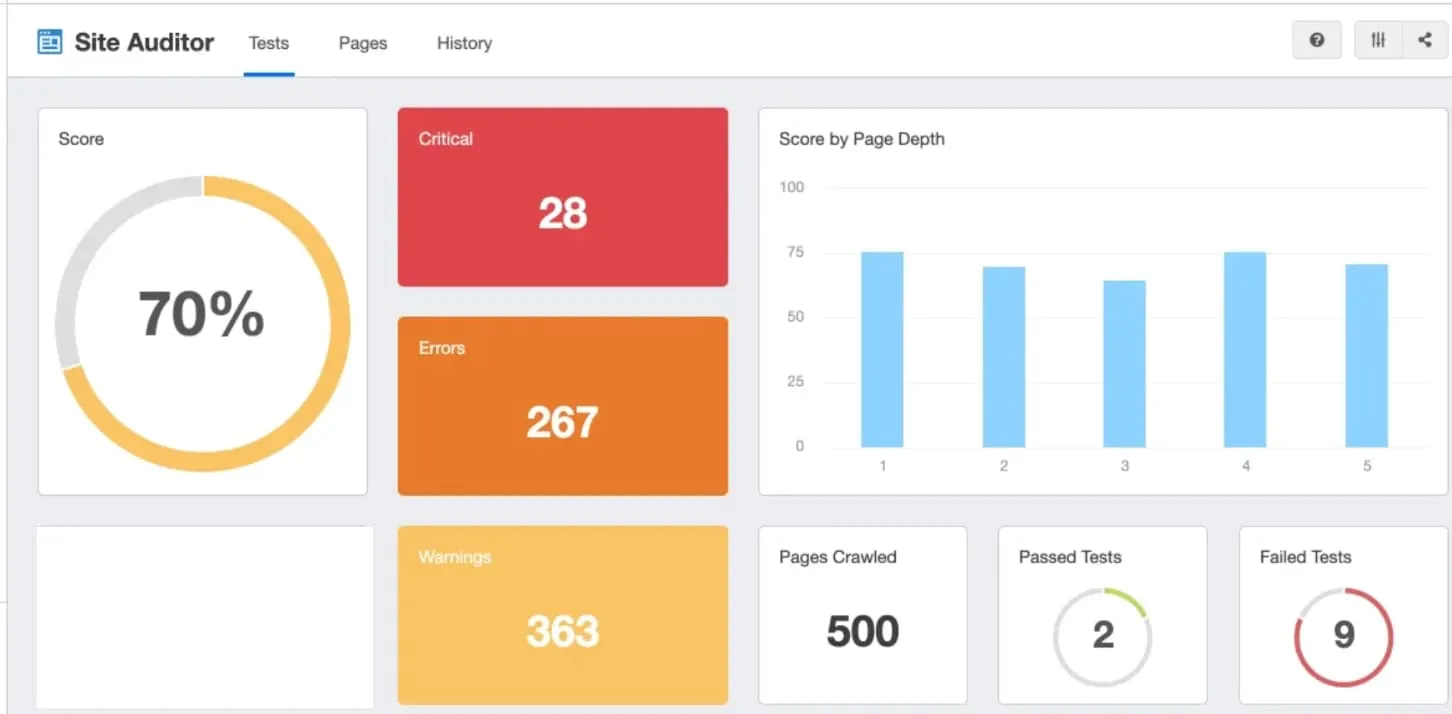
Doesn’t this screenshot look like many other scary audit results generated by audit tools? It lists 28 critical errors, 267 errors, 363 warnings. Add to this 9 failed tests. Scary right? It certainly appears so.
When you get hit with a report like this saying you have “4,200 Issues”, you naturally become panic-stricken.
Your initial goal of using the tool was probably reassurance that your site wasn’t broken, but instead you see this and it is easy to feel lost. Most likely at this point you don’t know that 50% of these “SEO danger” warnings don’t actually matter.
However, this visual stimulation you get from looking at dashboard results is just one of the reasons why you may feel confused.
Free SEO audit tools and hidden agenda you’d better be aware of
Another reason for the overwhelm is hidden agenda. This is especially true for “free” tools, also known as free SEO audit tools / health check free tools.
“Free” usually means a sales funnel: you are enticed by the word “free” but then realize that there is some sort of artificial limitation (e.g., you can use it free of charge only 2-3 times a day to scan your website).
But the real end goal of the free tool is to lead you further down their sales funnel to conversion into a paying customer. And there is nothing wrong with that; many well-known companies also do it.
The problem is that, in addition to some limitations, some of them can resort to dishonest tactics. Some of these tools ask you to “enter your URL for a free score” and are in fact scams designed to capture emails. That’s why they always find “critical issues”.
Some are there to lure you into using their tool by showing you made-up scores that sound official but in reality mean nothing. These scores are official according to the creators of the tool but not according to the world’s largest search engines (Google, Bing, etc).
Some minor things like “no meta description” can be flagged by these tools as major issues, when in fact they are not. While meta descriptions are useful for getting clicks, missing one is not a critical technical error, yet tools treat it like one.
This is why I mentioned earlier in the text that 50% of those scary critical “errors” don’t actually matter. They are not really critical and using scary colors is there for a purpose.
The result of all this is false positive fatigue: the tools “scream” at you about trivial things (like “missing meta descriptions”), make you panic and think about them as critical issues.
If I were to recommend any free SEO tools to you, they would be tools directly owned by search engines themselves: Google Search Console, a free tool you must have as a website owner, and Bing Webmaster Tools.
They are better than most paid tools for beginners. But you would need to educate yourself on how to use them.
Diversity of audit tools only adds to confusion
The next reason for feeling lost is that most entrepreneurs assume all SEO audit tools are roughly the same. They are not.
The confusion starts before you even run your first audit because the market is full of tools built for completely different users. Most of them are not built for you.
I’ve already covered free health check sites above. You now know enough about them. So let’s now look at another type of tool - technical scrapers, such as Screaming Frog.
This tool is well-known and recognized in the SEO industry and a lot of SEO professionals know how to use it and use it daily as a powerful website crawler designed for technical SEO audits. It gives you raw crawl data: response codes, directives, headers, resource maps, JavaScript rendering quirks, etc.
But to a small business owner? Tools like these assume you already understand canonicals, indexation rules, render depth, internal linking logic, etc. And if you don’t, you will be overwhelmed.
Not because you are not smart enough, but because they weren’t designed for beginners. If you are a technical SEO specialist or an enterprise team working on SEO, you will feel in your own element.
And finally you’ve most likely encountered all-in-one SEO audit tools or enterprise suites like Ahrefs, Moz, etc. However, what no one tells you is that tools like Ahrefs are built to track thousands of keywords and manage massive websites with hundreds of pages and are generally used by SEO or digital marketing agencies or enterprise teams at companies.
For a local plumber, a consultant, or a small bakery, or solopreneur using these tools would most likely be overkill and paying $120–$150/month for Ahrefs would probably be a waste of money.
Besides, just like technical scrapers, these tools throw data at you that require a deep understanding of SEO to interpret. The list of metrics could include link toxicity, visibility indices, etc.
| Tool Type | Best For | Cost | Beginner Friendly? |
|---|---|---|---|
| Free Scanners | Sales Funnel/Email Capture | "Freemium" | Yes (And Misleading) |
| Technical (Screaming Frog) | Devs / Technical SEO | Freemium / $$ | No (Steep Learning Curve) |
| Enterprise (Ahrefs/Semrush) | Agencies / Enterprise Teams | $$$$ | No (Overkill) |
You will naturally experience analysis paralysis. Instead of writing a good blog post (which would actually help you), you will spend 3 hours or more trying to understand the data presented and still may come to wrong conclusions about what to do next.
Why you are drawn to using SEO audit tools
While the above text explains why you may feel lost using SEO audit tools and why it is not your fault, there is a reason why you will still be drawn to using them. It is not obvious at first, because it is more on a subconscious level.
People crave simplicity: line/number go up = good, line/number go down = bad. These tools that give a score out of 100 and suggest how to get 100 are easy to understand and follow, regardless of whether the scores are made up or mean nothing or whether you will understand all accompanying data below the tool’s nice dashboard or know how to use it to your advantage.
However, please note that behind the seeming simplicity of the dashboard is hidden immense complexity of data, which you must understand in order to know what to do and what to ignore.
The desire to just click a button and get a simple and clear answer is understandable. I also want to just click a button or point my finger at a design and have my flat redecorated without doing anything, but it is just not possible.
I guess it is the same with organic search audit tools. Beautiful dashboards with scores are just not enough, you need to interpret data correctly to arrive at meaningful conclusions that would lead to meaningful results (more sales/signups).
Which SEO audit tool is actually “sane” to use?
Having said all that, I understand that some may desire a DIY approach and have time to study SEO and try to interpret data themselves.
If you absolutely insist on the DIY approach and want to see and interpret data for yourself, but don’t have the budget for enterprise tools or the patience for technical scrapers, there are some “user-friendly” and “budget” tools that are simpler than enterprise suites like Ahrefs and I think are better suited to small business needs.
Best-value SEO audit tool for small business
There is really no need to overpay for audit tools. Ahrefs and other enterprise solutions will cost a lot and will be overkill for what you need and you will feel lost in raw data.
Instead you can just grab the “Essential” plan of SE Ranking for $65.00 (monthly subscription) or save 20% with an annual subscription (just $52 per month). This is roughly half the price of premium SEO suites.
(no credit card)
Other benefits
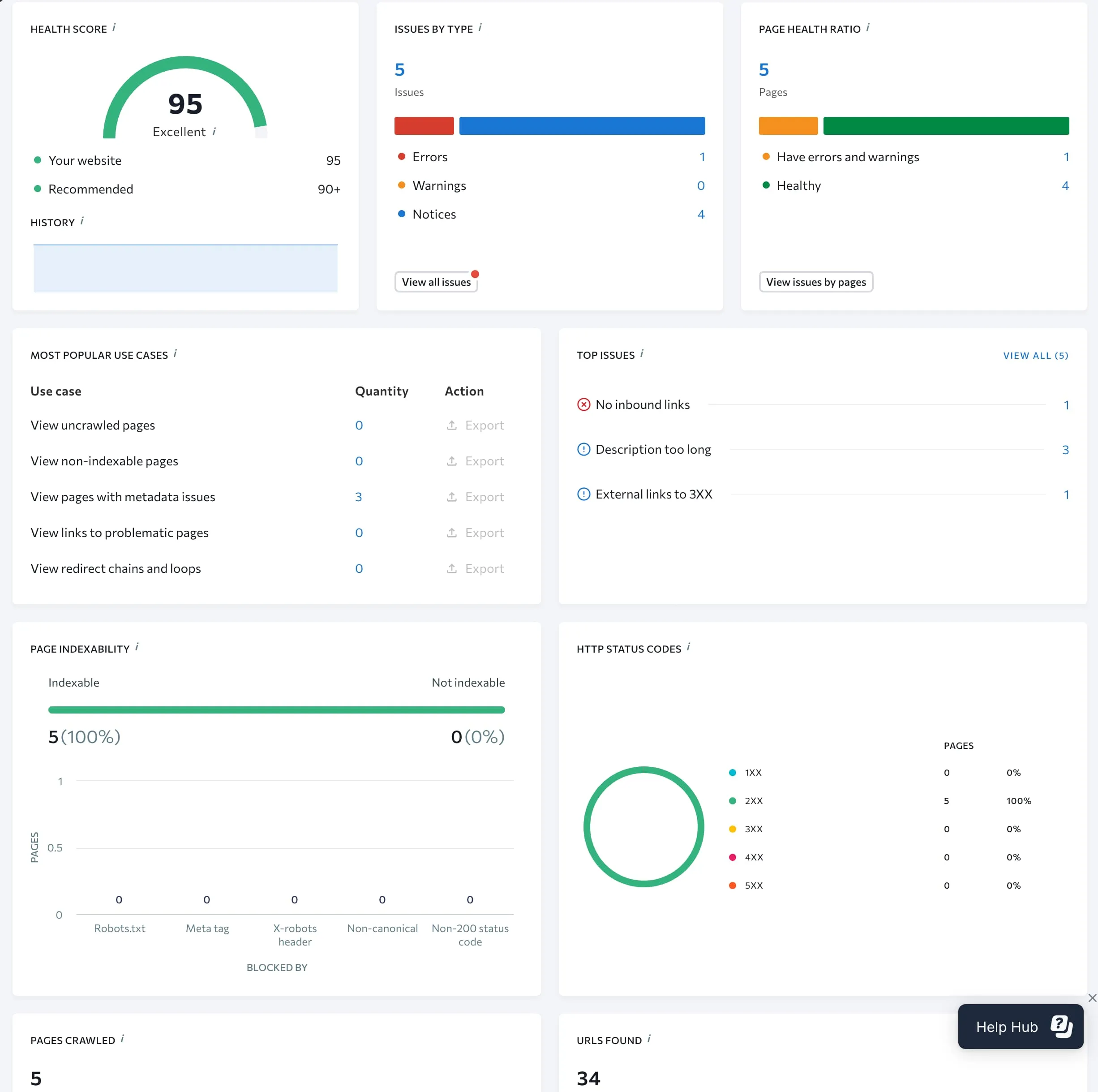
SE Ranking has a clear and intuitive dashboard, where you can monitor your site’s health, including such metrics as crawled pages, URLs found, top issues, Core Web Vitals, and an overall health score.
This high-level overview makes it possible for you to assess how well your website is optimized for organic search and make a list of priorities for improvement.
Below you can see a screenshot of a quick test audit I ran of a Vermont law firm website and these are the results. I am not going to interpret the results here, because this is not the topic of this article.
But what you can do is to try it yourself. There is a 14-day trial period, during which you can test different features and decide for yourself.
SMEs such as local businesses can utilize local SEO audits and keyword tracking to improve visibility in targeted areas for search queries “X near me”.
E-commerce companies, solopreneurs can also use SE Ranking to monitor product keyword rankings and conduct competitor research, while utilizing the website audit functionality to improve technical SEO and site performance.
Most importantly this tool has a ‘Marketing Plan’/Checklist’ feature, which may be helpful for beginners. It gives you a step-by-step checklist of what to fix first, so it basically holds your hand through the process.
(no credit card)
Just keep in mind that if you use the tool, it is assumed that you will allocate some time for learning SEO (while the tool guides you, you still need to understand the basics to get the best results). If you don’t have the time for SEO education, you have one more option (below).
Why you can’t blindly trust tools
While the tool mentioned above is a starting point, there is always something that is lacking: a tool can’t interpret for you; sometimes data needs to be verified manually; and it certainly does not know your business goals.
And any SEO advice must be tailored to your unique situation. In other words, the truth is that tools can’t fully replace human analysis.
A human, either you (once you’ve mastered the art of SEO) or an SEO professional, can understand your audience and create a time-bound strategic roadmap.
On the other hand, a tool can flash a warning “high bounce rate” but will not explain whether it is due to irrelevant content or other reasons. You need to investigate further to know the answer.
SEO tools are typically built to provide automatic suggestions to users. It does not matter for a tool whether you have a law firm or an e-commerce store and it does not care.
It also cannot replace a human when it comes to analyzing your UX/UI and design issues. It won’t notice whether your navigation is bad or CTAs do not make sense, while those may be the only reasons why your landing page does not lead to conversions.
Strategy is the goal
Human analysis is indispensable when doing professional SEO audits, because the whole purpose of them is to find what is wrong and what can be improved in the order of priority. The output of any SEO audit is a strategic action plan.
To come up with the strategic roadmap, you need a human brain to ensure that your recommendations are personalized, to analyze how real people search for you online (keyword analysis and keyword mapping), to see whether your website meets Google’s criteria of Experience, Expertise, Authoritativeness, and Trustworthiness (E-E-A-T), etc.
Given that the human element is unavoidable, there are two realistic options for you:
-
the DIY route discussed above: SE Ranking tool subscription ($52/mo) + learning curve + stress and some degree of uncertainty. This option is good for people with more time but who are reluctant to pay a hefty fee for enterprise tools.
-
the “paid SEO audit” route: a standalone service by an organic search consultant for a one-time fee without any long-term contracts. You can hire any SEO consultant of your choosing.
As an organic seo consultant I also offer a similar service – a strategic site audit, which serves as a strategic filter to sift through the noise and come up with a 90-day strategic action plan for your website. It is a great option for new or unsure website owners and delivers a quick, high-level overview of your site’s SEO health.
The package includes the following:
-
a 60-minute 1-on-1 strategy session;
-
a 10-minute executive video summary, and
-
an easy-to-read PDF that identifies the core issues.
It is designed to quickly give you everything you need to move forward with confidence.
It is also highly customized to your business goals. You’ll know exactly what’s wrong, what to fix, and where to focus next. All of these are included in the price ($499).
You pay for human expertise, clarity, direction and time of the dedicated SEO expert, who has done this many times before.
The strategic site audit becomes completely free ($0) if you want me to implement the strategic roadmap for you. Overall it seems like a good investment (not cost) in your organic growth.
Feeling lost is fine
It is okay to be lost when using SEO audit tools. You are a founder, a business owner, not an SEO professional. The hidden agenda of free SEO audit tools and a variety of tools do not add to clarity either.
So how do you achieve clarity regarding your own website and how to grow it organically?
Couldn’t you just use a free SEO audit tool? Sure, you could. But you could also cut your own hair. Just because you can doesn’t mean you should, especially given what I’ve described about free SEO audit tools and why you should be cautious.
Couldn’t you just use a more reliable paid tool and run your own checks? Sure, you could use SE Ranking due to benefits described above but you will have to know what you are doing and build an action plan for yourself, which implies SEO knowledge and expertise.
Couldn’t you just use the paid SEO audit option? Sure, you could. You will skip the learning curve, just get a plan and save lots of time, which could otherwise be spent on growing your business.
Don’t stay paralyzed by the data. Either grab the SE Ranking trial to see the clearer picture yourself, or book the audit and have the SEO strategy prepared for you.

Pav Polyarush